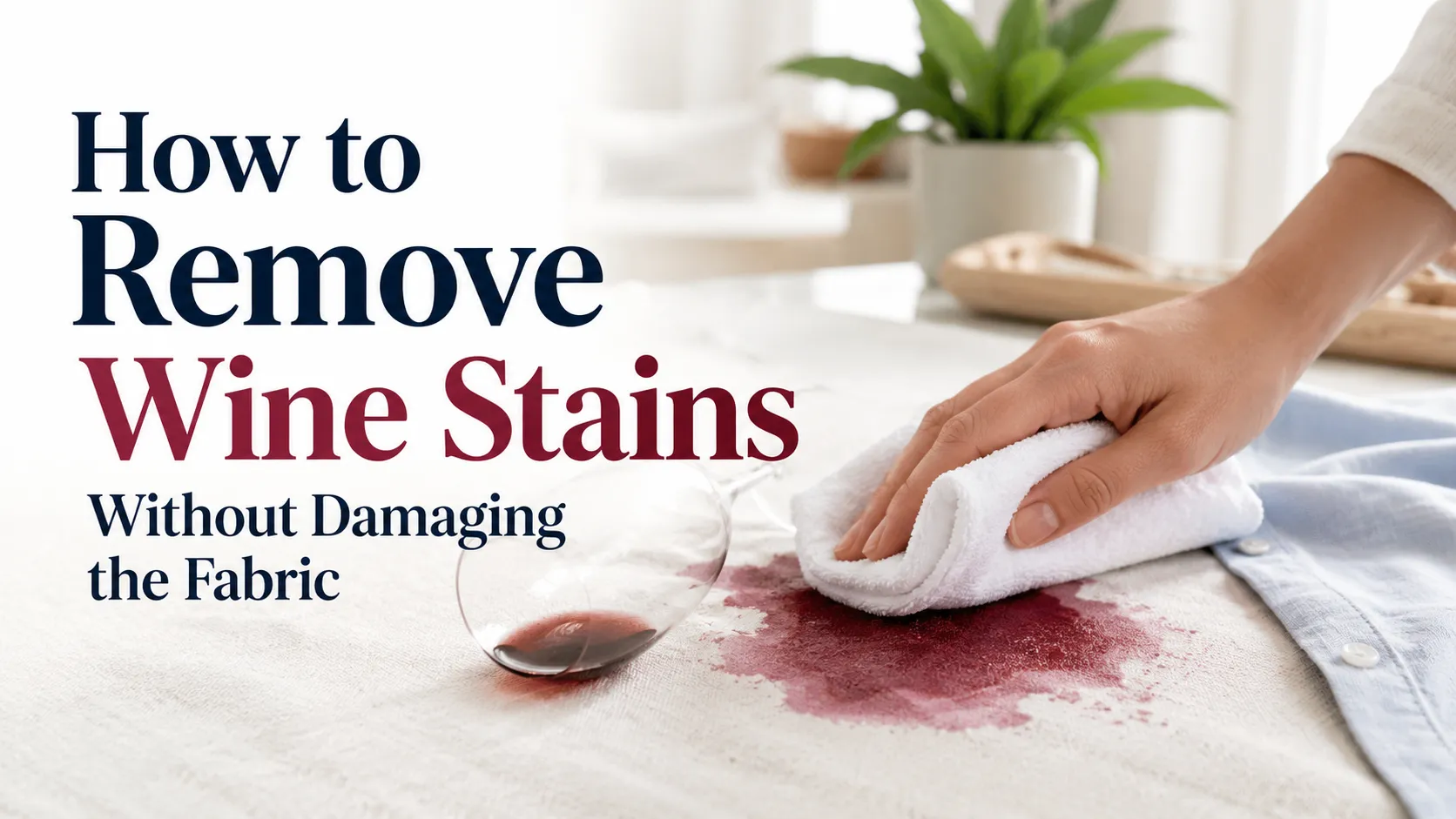
A wine spill does not call for the strongest cleaner you can find. Start by blotting up the excess liquid, identify the stained material, and then choose a treatment that fits the surface and its care instructions.
That distinction matters because a washable cotton shirt, a carpet, and a sofa cushion cannot be treated in the same way. Fresh spills also need a different response from stains that have already dried. Acting promptly helps, but careful treatment matters more than piling several household remedies onto the same spot.
What to Do Immediately After a Wine Spill
For a fresh spill, remove as much liquid as possible before introducing a cleaner. Press a clean white absorbent cloth or plain paper towel against the wet area, then lift it away. Move to a clean section of the cloth as wine transfers onto it.
Blot rather than scrub. On carpet in particular, aggressive rubbing can spread the spot and disturb the fibers. A similar gentle approach makes sense on other textiles when you are trying to remove liquid without enlarging the affected area.
Use this sequence before deciding on a stain remover:
-
Blot up excess wine with a clean absorbent cloth.
-
Keep changing to a clean part of the cloth as it picks up color.
-
Identify whether the stained material is washable fabric, carpet, upholstery, or a delicate or dry-clean-only textile.
-
Check the care label or manufacturer’s cleaning instructions.
-
Test a treatment in a hidden area when the product or material calls for it.
-
Continue with the method intended for that particular surface.
Use one treatment according to its directions instead of combining several cleaners. In particular, never mix household bleach with other cleaning products.
The immediate goal is to control the spill and preserve your options. You do not need to solve every trace of discoloration in the first minute.
Choose the Method by Surface, Not by the Stain Alone
Red wine may be the common problem, but the material underneath it determines what you can safely do. A removable tablecloth can be rinsed and washed. Carpet needs spot treatment and residue removal. Upholstery may restrict how much moisture reaches the fabric and padding.
Use the surface to choose the right branch:
| Situation | Good first direction | Main concern |
|---|---|---|
| Washable clothes or table linens | Pretreat and launder according to the care label | Check the stain before tumble drying |
| Carpet or rug | Blot and use a compatible carpet spot treatment | Avoid scrubbing and unnecessary saturation |
| Fabric upholstery | Use controlled moisture and an approved upholstery cleaner | Keep liquid from soaking deeply into the cushion |
| Delicate or dry-clean-only textile | Limit home treatment and follow care instructions | Protect fibers, dyes, and finishes |
| Dried or older stain | Pretreat again as the material allows | More than one treatment may be necessary |
This surface-first approach also explains why household wine-stain advice can seem contradictory. A method suitable for a washable white tablecloth does not automatically belong on colored upholstery or a wool garment.
Remove Wine Stains From Washable Clothes and Linens
For washable clothing and household linens, start with the care label. It determines the washing, bleaching, and drying conditions that are appropriate for the item.
After blotting a fresh spill, rinse the stained section with cool water when the fabric can be rinsed normally. Then apply a laundry stain remover or detergent suitable for the textile. Follow the product’s stated contact time rather than leaving it on indefinitely because the mark looks stubborn.
A straightforward laundry workflow is:
-
Blot excess wine from a fresh stain.
-
Read the care label.
-
Rinse the affected section with cool water if the fabric permits it.
-
Apply a compatible laundry pretreatment.
-
Wash using the warmest water temperature allowed by the garment’s care instructions and the treatment product.
-
Inspect the stained area before putting the item in a tumble dryer.
If discoloration remains after washing, repeat an appropriate pretreatment before drying. Avoid automatically increasing the amount of cleaner or combining products.
For Colored Washable Fabrics
Colorfastness becomes important when you move beyond normal detergent. A product marketed as suitable for colors can still have restrictions based on fiber, dye, or garment construction.
Oxygen-based laundry products may be an option for some washable colored fabrics. Use them only when the garment care instructions and the product label allow the treatment. If testing is recommended, try the product on an inside seam or another inconspicuous area first.
A faint remaining stain after the first wash does not mean you need a harsher product immediately. Repeating a compatible pretreatment is often the more controlled next step.
For White Bleach-Safe Fabrics
Do not assume that every white garment can be treated with chlorine bleach. The care label still determines whether chlorine bleach, non-chlorine bleach, or no bleach should be used.
If chlorine bleach is permitted, follow its label and the garment instructions exactly. When it is not permitted, use another treatment that is compatible with the fabric.
Color is only one part of the decision. Fiber content, finishes, trims, and construction also affect what the item can tolerate.
Get Wine Out of Carpet Without Spreading the Spot
Carpet cannot be rinsed like a shirt, so control over moisture and cleaner residue becomes more important.
Blot a fresh wine spill with a clean white cloth, pressing down and lifting rather than rubbing back and forth. When working on the remaining spot, move gently from its outer edge toward the center to help keep the affected area from expanding.
Before applying a cleaner, confirm that it is intended for the carpet and test it in an inconspicuous area when recommended. This matters especially for strongly colored rugs, unknown fibers, and carpets with uncertain dye stability.
A controlled carpet-cleaning sequence is:
-
Blot up as much liquid as possible.
-
Apply a small amount of a compatible carpet spot treatment.
-
Blot the treated section rather than scrubbing it.
-
Repeat gradually while color continues transferring to the cloth.
-
Remove remaining cleaning product as directed, which may include blotting with clean water.
-
Let the area dry and inspect it again.
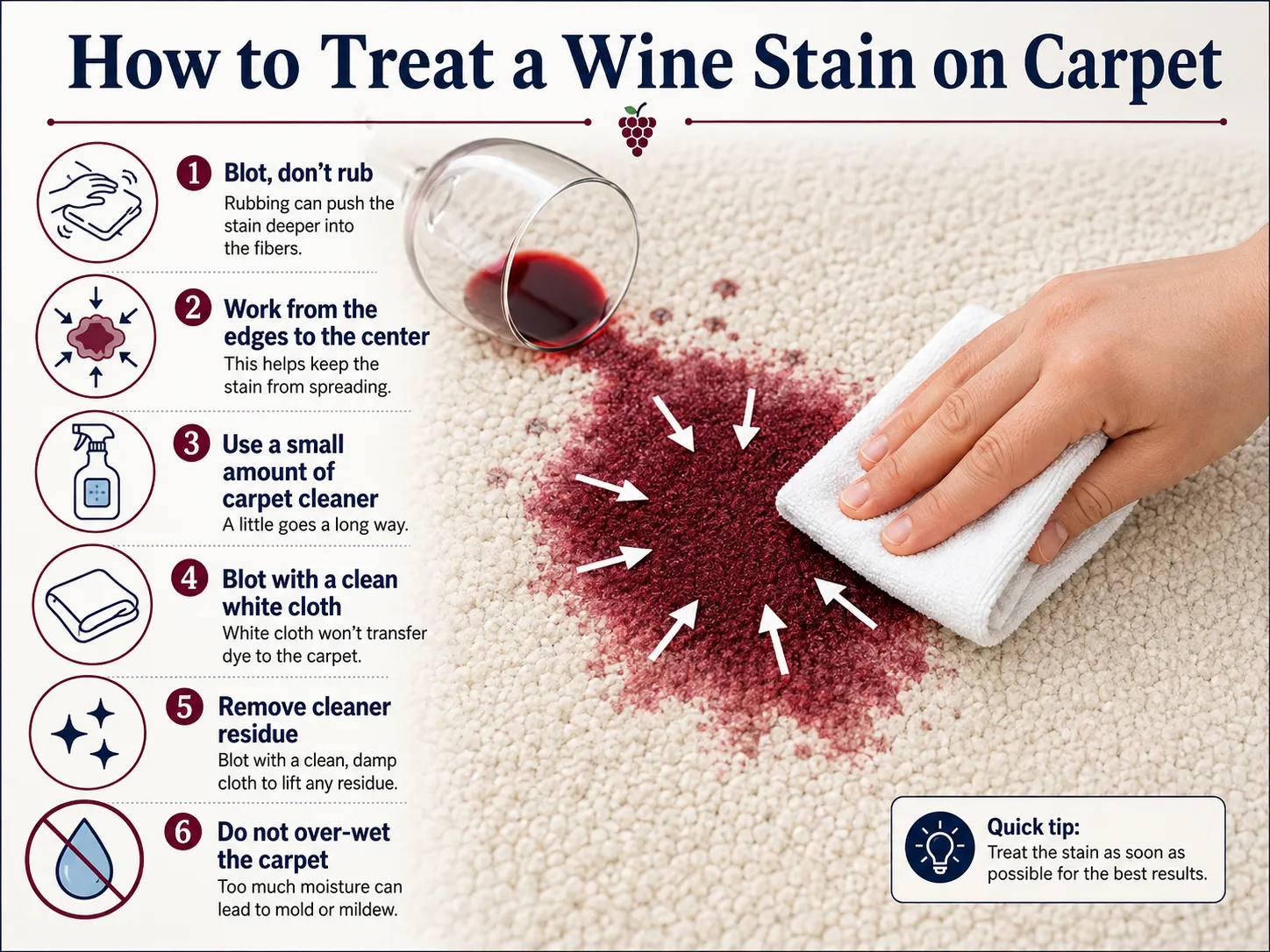
Avoid flooding the spot. More liquid is not necessarily more effective, and unnecessary saturation can carry moisture below the visible carpet fibers.
If a stain remains after the area dries, repeat an appropriate carpet treatment rather than pouring several different products over the same location.
Treat a Wine Stain on a Couch or Upholstery
Upholstery needs more restraint than washable fabric because the visible covering may sit over foam, batting, backing, or other materials that should not be saturated.
Blot the spill first, then check the furniture manufacturer’s care instructions. Use a cleaner intended for that type of upholstery rather than assuming a laundry or carpet product is interchangeable.
Test the cleaner in a hidden area if required. Look for more than simple color loss. A treatment can also create a water ring, change texture, or cause dye to transfer to the cleaning cloth.
Apply only the amount of liquid needed for the approved treatment. Work on the fabric rather than soaking the cushion beneath it, then remove cleaner residue in the manner recommended for the upholstery.
A removable cover is not automatically machine washable just because it has a zipper. Check its care instructions before taking it off and putting it in the washer.
For valuable furniture, delicate fabric, uncertain cleaning instructions, or a large spill that has soaked deeply into the cushion, professional upholstery cleaning may be preferable to repeated experiments.
What to Do With a Dried or Previously Washed Wine Stain
Once wine has dried, there is no excess liquid left to blot. The task changes from absorbing the spill to loosening and removing residue that remains in the material.
For washable clothing, apply a compatible stain pretreatment and follow its directions. Some products and fabrics also permit soaking before laundering. Use only the solution and contact time allowed for the textile and cleaner rather than relying on a universal overnight-soak rule.
Older stains may need another treatment cycle. After laundering, inspect the affected area and repeat an appropriate pretreatment if discoloration remains.
If the garment has already been tumble-dried with the stain still present, removal may be more difficult. Do not assume that a stronger cleaner will necessarily restore the material completely.
Dried carpet stains can also be treated again with a compatible carpet-cleaning solution. Use controlled amounts and follow the same rules about blotting, testing, and removing cleaner residue. For upholstery, keep the material’s moisture limits and care instructions in mind.
Age alone does not tell you whether a stain will come out. Fiber type, dye, previous treatment, and exposure to drying heat all influence what remains possible, so avoid methods that promise guaranteed removal of every old wine mark.
Adjust the Method for Delicate and Dry-Clean-Only Fabrics
Silk, wool, structured garments, specialty textiles, and dry-clean-only items should not automatically receive the same procedure as a washable cotton shirt.
Read the care label before applying a stain remover or soaking the material. If home washing is prohibited, gently blot a fresh spill without spreading it and arrange professional cleaning rather than escalating through bleach or stronger household products.
Tell the cleaner that the stain came from wine and mention anything already applied to it. Knowing the treatment history helps distinguish an untouched stain from one that has already been exposed to detergent or another cleaner.
Even when a delicate item is technically washable, stay within its care instructions. Stop home treatment if a test area loses color, the surface texture changes, or the fabric begins to distort. A remaining stain is usually preferable to irreversible damage caused by an incompatible cleaner.
Check the Stain Before You Dry the Fabric
For washable clothing and linens, inspect the treated area after washing and before tumble drying. If a visible mark remains, repeat an appropriate fabric-safe treatment while you still have that option.
There is no benefit in throwing additional cleaners at a faint stain without checking compatibility first. Repeat the existing method when appropriate, choose another treatment allowed by the care instructions, or hand the item to a professional cleaner when the material no longer tolerates home treatment.
The simplest way to approach wine stains is to let the surface and care instructions determine the method. Blot fresh spills promptly, use a laundry process for washable textiles, control moisture on carpet and upholstery, and treat older stains without assuming that stronger chemistry is always the answer.
FAQ
Can club soda remove a red wine stain?
Club soda is a common home remedy, but it is not necessary for most stains. Blot first, then use a treatment that is appropriate for the specific fabric, carpet, or upholstery.
Can I use baking soda on a wine stain?
Baking soda is sometimes suggested for wine stains, but it is not suitable for every textile or finish. Check the material and care instructions before using any household treatment.
Should I use hot or cold water on a red wine stain?
Cool water is a reasonable starting point for rinsing many washable fabrics. For the actual wash, follow the garment care label and use the warmest temperature permitted for that item and treatment.
Can an old red wine stain still be removed?
Sometimes. Older or previously washed stains may respond to another compatible pretreatment or soak, but they can require several attempts and may not disappear completely.
When should I take a wine-stained item to a professional cleaner?
Consider professional cleaning for dry-clean-only garments, delicate materials such as silk or wool, valuable upholstery, deeply soaked cushions, or any item that begins losing color or changing texture during home treatment.